Redis 实践笔记,redis实践笔记
最近在项目中实践了一下Redis,过程中遇到并解决了若干问题,记录之.{
public User()
{
this.BlogIds = new List<long>();
}
public long Id { get; set; }
public string Name { get; set; }
public List<long> BlogIds { get; set; }
} 使用下面的代码片段,我们存入两条数据到Redis:
using (var redisUsers = redisClient.GetTypedClient<User>())我们看下Redis中的结果:
{
var ayende = new User { Id = redisUsers.GetNextSequence(), Name = "Oren Eini" };
var mythz = new User { Id = redisUsers.GetNextSequence(), Name = "Demis Bellot" };
redisUsers.Store(ayende);
redisUsers.Store(mythz);
}
redis 127.0.0.1:6379[1]> keys *我们逐一检查一下数据类型:
1) "seq:User"
2) "ids:User"
3) "urn:user:1"
4) "urn:user:2"
| seq:User | string | 维护当前类型User的ID自增序列,用做对象唯一ID |
| ids:User | set | 同一类型User所有对象ID的列表 |
| urn:user:1 | string | user对象 |
public long GetNextSequence(int incrBy)这里的SequenceKey就是 "seq:User",然后我们通过存一个对象到Redis看另外两个key是什么作用:
{
return IncrementValueBy(SequenceKey, incrBy);
}
public long IncrementValue(string key)
{
return client.Incr(key);
}
public T Store(T entity)这里的typedIdsSetKey 就是"ids:User" ids:User相当于一个索引,包含了所有同为类型User的ID;由于维护了这样一个分组信息,所以很容易实现GetAll<User>()这样的功能; 在redis-cli中查询一下 get urn:user:1 返回值是JSON格式: "{\"Id\":1,\"Name\":\"Oren Eini\",\"BlogIds\":[1]}" ServiceStack.Redis 自己实现了一套序列化功能,Fastest JSON Serializer for .NET released 支持 POCO(Plain Old CLR Object)序列化. 实际应用中,由于我们使用的数据是来自关系型数据库,本身包含关联关系,所以并不需要这样的对象组织方式;我们只需要把关系型数据中一对多的关系在Redis中表达出来即可;这里我扩展修改了RedisClient的实现,由于RedisClient本身已经通过partial方式分割成若干个文件,所以很容易把变动的代码集中在同一个代码文件中.具体业务对象存储,主帖和回帖会有字段级修改,所以设计成为Hash结构,其它几个子对象读写都是以对象为单位,设计成为POCO方式持久化;
{
var urnKey = entity.CreateUrn();
this.SetEntry(urnKey, entity);
return entity;
}
//entity.CreateUrn();的结果是"urn:user:1"
public void SetEntry(string key, T value)
{
if (key == null)
throw new ArgumentNullException("key");
client.Set(key, SerializeValue(value));
client.RegisterTypeId(value);
}
internal void RegisterTypeId<T>(T value)
{
var typeIdsSetKey = GetTypeIdsSetKey<T>();
var id = value.GetId().ToString();
if (this.Pipeline != null)
{
var registeredTypeIdsWithinPipeline = GetRegisteredTypeIdsWithinPipeline(typeIdsSetKey);
registeredTypeIdsWithinPipeline.Add(id);
}
else
{
this.AddItemToSet(typeIdsSetKey, id);
}
}
使用管道Pipeline遇到的问题 使用管道可以将客户端到Redis的往返次数减少,不过在使用ServiceStack.Redis的时候,遇到这样一个问题,比如要把一个List<log>全部存储,代码不可以写成下面这样:
%%第一种写法而是要写成这样:
logs.ForEach(n =>
{
pipeline.QueueCommand(r =>
{
((RedisClient)r).Store<OpLog>(n, n.GetObjectID(), n.GetUrnKey());
((RedisClient)r).Expire(n.GetUrnKey(), dataLifeTime);
});
});
%%第二种写法什么原因呢?RedisQueueCompletableOperation的AddCurrentQueuedOperation方法会在 执行CurrentQueuedOperation = null;如果按照第一种写法会丢失回调函数,这就造成有返回值在没有及时提取,后续的操作获取返回值时首先取到的是积压的结果信息,就出现了异常,而第二种写法就避免了这个问题.
logs.ForEach(n =>
{
pipeline.QueueCommand(r => ((RedisClient)r).Store<Log>(n, n.ID, n.GetUrnKey()));
pipeline.QueueCommand(r => ((RedisClient)r).Expire(n.GetUrnKey(), dataLifeTime));
});
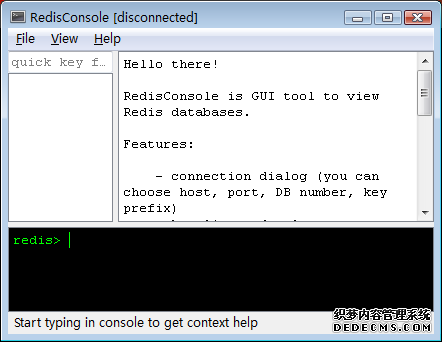
protected virtual void AddCurrentQueuedOperation()Redis工具篇 Redis的客户端redis-cli不是太好用,退格键和箭头都不能正常使用,这个的确影响效率,还是需要找一个合适的工具,我比较喜欢这个:RedisConsole https://github.com/ptrofimov/RedisConsole/downloads 这个工具用来学习是很好用的,但是数据量一旦增大,左侧列表就混乱了,而且一点击就假死;所以建议只在学习阶段使用;
{
this.QueuedCommands.Add(CurrentQueuedOperation);
CurrentQueuedOperation = null;
}
Redis图书资料: [1] Big Data Glossary - O'Reilly Media [2] The Little Redis Book by Karl Seguin [3] Redis Cookbook (O'Reilly Media, 2011) [4] Professional NoSQL (Wrox, 2011)
刚刚在NOSQLFan上看到一篇<Memcached真的过时了吗?>一定要转过来: 原文: http://blog.nosqlfan.com/html/3729.html
这两年Redis火得可以,Redis也常常被当作Memcached的挑战者被提到桌面上来。关于Redis与Memcached的比较更是比比皆是。然而,Redis真的在功能、性能以及内存使用效率上都超越了Memcached吗?
下面内容来自Redis作者在stackoverflow上的一个回答,对应的问题是《Is memcached a dinosaur in comparison to Redis?》(相比Redis,Memcached真的过时了吗?)
- You should not care too much about performances. Redis is faster per core with small values, but memcached is able to use multiple cores with a single executable and TCP port without help from the client. Also memcached is faster with big values in the order of 100k. Redis recently improved a lot about big values (unstable branch) but still memcached is faster in this use case. The point here is: nor one or the other will likely going to be your bottleneck for the query-per-second they can deliver.
- 没有必要过多的关心性能,因为二者的性能都已经足够高了。由于Redis只使用单核,而Memcached可以使用多核,所以在比较上,平均每一个核上Redis在存储小数据时比Memcached性能更高。而在100k以上的数据中,Memcached性能要高于Redis,虽然Redis最近也在存储大数据的性能上进行优化,但是比起Memcached,还是稍有逊色。说了这么多,结论是,无论你使用哪一个,每秒处理请求的次数都不会成为瓶颈。(比如瓶颈可能会在网卡)
- You should care about memory usage. For simple key-value pairs memcached is more memory efficient. If you use Redis hashes, Redis is more memory efficient. Depends on the use case.
- 如果要说内存使用效率,使用简单的key-value存储的话,Memcached的内存利用率更高,而如果Redis采用hash结构来做key-value存储,由于其组合式的压缩,其内存利用率会高于Memcached。当然,这和你的应用场景和数据特性有关。
- You should care about persistence and replication, two features only available in Redis. Even if your goal is to build a cache it helps that after an upgrade or a reboot your data are still there.
- 如果你对数据持久化和数据同步有所要求,那么推荐你选择Redis,因为这两个特性Memcached都不具备。即使你只是希望在升级或者重启系统后缓存数据不会丢失,选择Redis也是明智的。
- You should care about the kind of operations you need. In Redis there are a lot of complex operations, even just considering the caching use case, you often can do a lot more in a single operation, without requiring data to be processed client side (a lot of I/O is sometimes needed). This operations are often as fast as plain GET and SET. So if you don’t need just GEt/SET but more complex things Redis can help a lot (think at timeline caching).
- 当然,最后还得说到你的具体应用需求。Redis相比Memcached来说,拥有更多的数据结构和并支持更丰富的数据操作,通常在Memcached里,你需要将数据拿到客户端来进行类似的修改再set回去。这大大增加了网络IO的次数和数据体积。在Redis中,这些复杂的操作通常和一般的GET/SET一样高效。所以,如果你需要缓存能够支持更复杂的结构和操作,那么Redis会是不错的选择。
注意:实践版本 Redis 2.4.92013-3-22 16:30:30 更新
Rdbtools is a parser for Redis' dump.rdb files. The parser generates events similar to an xml sax parser, and is very efficient memory wise.
In addition, rdbtools provides utilities to :
https://github.com/sripathikrishnan/redis-rdb-tools
本站文章为和通数据库网友分享或者投稿,欢迎任何形式的转载,但请务必注明出处.
同时文章内容如有侵犯了您的权益,请联系QQ:970679559,我们会在尽快处理。